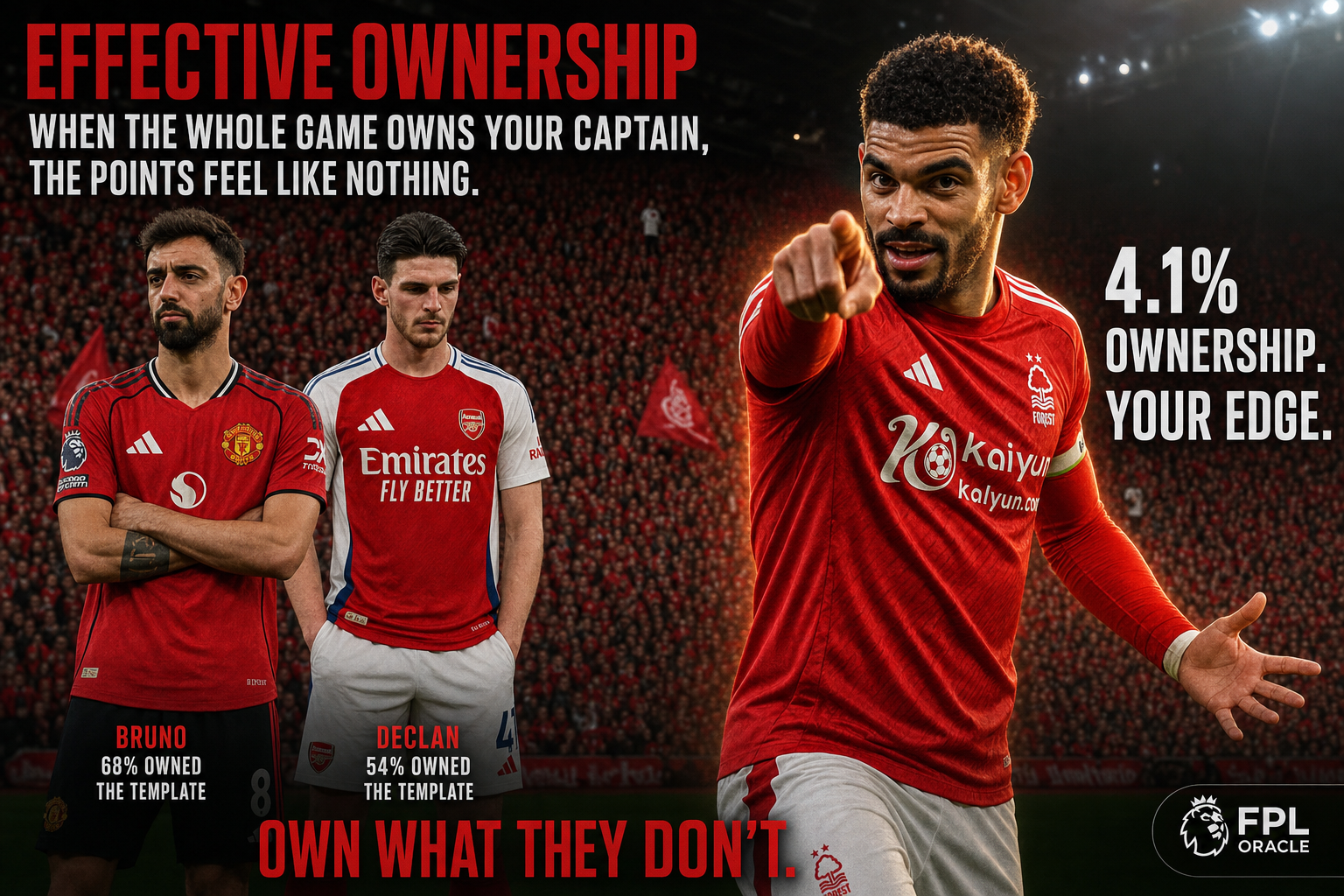
Here is a question most FPL managers cannot answer correctly: if a player is owned by 50% of the game and you captain him, how much does his haul actually affect your rank? The instinct is to say "a lot" — but the honest answer is "barely at all". That is the trap of raw ownership. Effective ownership (EO) is the number that tells you the truth. It accounts for the captain multiplier, vice-captain fallback, and the bench structure of everyone around you — and it completely changes the captaincy calculation. Get it wrong and you are grinding your rank for nothing. Get it right and you can make asymmetric decisions that gain rank where others bleed it. This guide covers everything: what EO is, how to calculate it, how it differs from ownership, and most importantly, exactly how to use it to make better captaincy calls every single gameweek.
What Is Effective Ownership — And Why Raw Ownership Misleads You
Raw ownership is the percentage of all FPL teams that contain a given player. If a player sits in 60% of squads, his raw ownership is 60%. Simple. But raw ownership tells you nothing about how much rank exposure you have to that player's score. Two managers can both own a player and have wildly different rank sensitivity to him — because of how they deploy him.
Effective ownership is the adjusted ownership figure that accounts for the captain multiplier. The official FPL rules confirm that the captain earns double points, which means captaining a player doubles your points exposure to him. A player you own but do not captain contributes 1× his score. A player you captain contributes 2×. If the rest of the game is also captaining him, that 2× exposure is neutralised — you all rise and fall together. But if you captain him and most of the game does not, you have a genuine rank advantage on a green arrow and a genuine rank loss on a red arrow.
The simplified EO formula is: EO = Ownership% + Captain%. If a player is owned by 50% of the game and captained by 40% of those managers, his EO is roughly 50% + 40% = 90%. That means 90% of active managers are effectively exposed to his score at full weight. Captaining him against that backdrop gains you almost nothing on a haul — the whole game rides with you. But it costs you hard rank if he blanks.
This is the fundamental insight most managers miss: EO is what determines your relative rank movement, not raw ownership. A player owned by 60% but only captained by 10% has an EO of 70% — still high, but the captain differential means there IS alpha available if you captain him and outperform the herd's captaincy choice. Conversely, a differential owned by only 15% who everyone who owns him is captaining has an EO of 30% — meaningful exposure even at low ownership.
How to Calculate Effective Ownership Accurately
The full EO calculation is more nuanced than the shorthand above. A complete model includes:
1. Base ownership: The percentage of teams containing the player (1× exposure). 2. Captain rate among owners: The proportion of the player's owners who also captain him (adds another 1× on top). 3. Vice-captain fallback: If the captain does not play, the vice-captain scores double instead. This creates a partial EO contribution from vice-captain rates. 4. Bench weight: A player on the bench contributes to EO only when he comes on — but for starters, bench weighting is negligible and usually excluded from the headline figure.
In practice, the headline EO figure you will see on tools like livefpl.net's live ownership tracker uses the simplified formula: ownership% + (ownership% × captain rate among owners). For most captaincy decisions this is precise enough. The vice-captain adjustment matters most when the primary captain is a doubt — something to layer in when you are choosing a VC with genuine playing risk on your captain.
The key numbers to know: a player with 50% ownership and 70% captain rate among his owners has an EO of approximately 85%. That is almost the entire active game riding on his score. At 85% EO, blanking him as captain costs you enormous rank. Hauling does nothing for rank — everyone goes with you. The value is almost entirely on the downside. This is a near-zero-EV captaincy decision unless you have very strong conviction he will haul.
The EO Thresholds That Change Your Decision
Not all EO levels carry the same strategic implication. Here is a practical framework:
EO above 70%: Captaining this player is a rank-neutral to rank-negative decision in expectation. If he hauls, you keep pace. If he blanks, you lose rank to anyone who went elsewhere. The only case for captaining above 70% EO is if you have very strong conviction the expected points are significantly higher than any alternative — and even then, you are playing a low-variance game that caps your upside.
EO 40–70%: This is the most common zone and the trickiest. The player is popular enough that blanking him stings, but the captain rate is not so concentrated that a haul moves nobody relative to you. At this level, the decision pivots on expected points differential: if your alternative captain has meaningfully higher EV (even 1–2 expected points), the EO math can favour the differential. If the popular pick is clearly the best expected-points choice, captaining him at 50% EO is still fine — you are not sacrificing upside, just running with the field.
EO below 40%: This is where contrarian captaincy creates genuine asymmetric rank upside. If a player has 25% EO and hauls, 75% of the game takes a relative rank hit. You gain rank on three-quarters of the field in one gameweek. The downside is symmetric — blanking costs you relative to 75% of managers. But this is where bold, high-conviction differential captaincy lives.
For the full framework on when and how to play the contrarian angle, our guide to template vs differential decision-making covers the EO thresholds that shift the call at every rank tier.
EO and Captaincy: The Rank-Dependent Layer
Here is the layer most EO guides skip entirely: the right EO threshold for your captaincy call depends on your current rank. This is not a minor adjustment — it fundamentally changes how you should use EO data.
If you are sitting at rank 500,000 and your mini-league is tight, your competitor pool is narrow. You care far more about beating the 20 managers in your league than the 11 million in the game. Your effective competition set has its own EO distribution — and it may be very different from the gamewide average. A player with 50% gamewide EO might only have 20% EO within your mini-league if your group skews toward differentials. Knowing that changes the math completely.
If you are chasing an overall rank target — say, top 50k from rank 300k — you need asymmetric upside. High-EO captains deliver rank stability but not rank gains. You need lower-EO captaincy picks that can outperform the field when they land. The math here is clear: you cannot climb rank by always going with the highest-EO captain. You will track the field. Our guide on rank protection vs rank climbing maps exactly when to prioritise stability vs upside, with EO as the central variable.
Conversely, if you are sitting at rank 8,000 near the end of the season, protecting that rank means minimising variance — which means tracking the high-EO captain almost every week. You are not trying to gain rank; you are trying not to lose it.
EO in Practice: Reading a Live Gameweek
EO is most actionable in the 24–48 hours before a deadline. Here is how to read it in real time:
Step one: check the ownership% of your top 2–3 captain candidates. Step two: find the captain rate — this is usually available on live ownership tools. Step three: calculate EO for each (ownership + ownership × captain rate). Step four: compare EO against your expected points estimate for each player. Step five: factor in your rank situation — are you protecting or climbing?
The practical output is not just "captain X" — it is a rank-adjusted decision. A player with EO 80% and EV 8.5 points is a very different proposition to a player with EO 30% and EV 7.0 points, depending on what you are trying to achieve. The raw expected points difference of 1.5 is real, but so is the rank-exposure gap of 50 EO percentage points.
The one mistake to avoid: using raw ownership instead of EO to make the call. A player owned by 60% of teams might only have an EO of 65% if his captain rate is low — far less rank-threatening than his ownership suggests. And a player owned by 30% but captained by almost everyone who owns him might have an EO of 55% — more rank-sensitive than his headline ownership implies.
Ownership tells you who has the player. Effective ownership tells you how much the game actually rides on his score. The two numbers can tell completely different stories — and only one of them should drive your captaincy decision.
EO for Vice-Captain: The Most Under-Used Edge
Most managers treat the vice-captain slot as an afterthought — a backup for if the captain does not play. That is leaving rank points on the table.
Your vice-captain matters when: (a) your captain is a doubt or has late fitness news, (b) there is a genuine playing-time risk on your captain due to rotation, or (c) you are making a punt on a differential captain and want a safer floor.
From an EO perspective, the vice-captain slot has low EO visibility — most managers assign it mechanically and rarely track VC captain rates. This means genuine alpha is available. If your captain blanks and your VC hauls while most of the game's VCs also blank, you gain rank from the VC slot — often significantly. Choosing a VC with lower EO than the conventional choice is a small but compounding edge across a season.
The rule: your VC should not be the highest-EO player in the game. Pick someone with a plausible haul route who is not universally held as VC. The downside if your captain plays is zero — the VC score is irrelevant. The upside if your captain does not play and your VC hauls while others blank is a meaningful green arrow.
The Proof: What EO-Aware Captaincy Actually Does to Your Rank
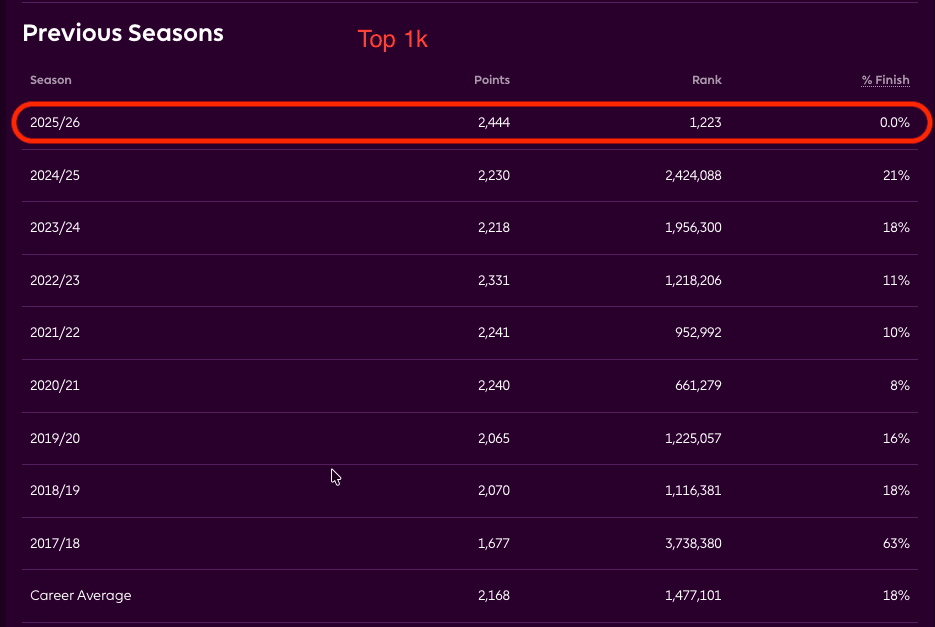
This is not just theory. One FPL Oracle user applied EO-aware captaincy consistently across a season and moved from rank 240,000 to inside the top 1,200 — comfortably inside the top 0.05% of the game. The screenshot below shows the actual rank trajectory.
The template/differential split plays out in real squads every week. A heavily-owned captain option like Haaland — owned by well over half the game — carries high EO almost by default; hauling with him barely moves your rank relative to the field, because the field owns him too. A genuine differential, like a heavily under-owned in-form midfielder such as Anderson, sits at a fraction of that ownership. If a player like that hauls while you have him and most of the game does not, the rank gain is real and immediate. Neither example is a recommendation to buy either player specifically — it is the EO gap between them that matters, and that gap exists at any point in a season.
FPL Oracle is not just a theoretical framework here, either — the product's own tracked FPL team currently sits at rank 279 out of over 13 million, playing by exactly the EO-aware logic described in this guide.
The Oracle Takeaway
Effective ownership is the single most important stat for captaincy decisions that most managers either do not know about or do not use correctly. The core insight: it is not enough to know who owns a player — you need to know how much the game's points are riding on him when the multiplier is applied.
Three actions to take immediately: First, stop using raw ownership as your captaincy input — always convert to EO before making a call. Second, set your EO threshold based on your rank situation: above 70k, you need some EO alpha; below 50k near season end, you should track the field. Third, spend 5 minutes on your VC choice each week — it costs nothing and compounds across a season.
A quick framework: if your top captain pick has EO above 75% and your next-best option has EO below 50% with expected points within 1.5 of the favourite, the differential case is worth serious consideration — especially if you are chasing rank. If you are protecting rank, stay with the high-EO pick only if the EV gap is at least 2 points.
FPL Oracle accounts for effective ownership automatically in every captaincy recommendation it makes. When you ask Oracle "who should I captain this week?", it does not just return the player with the highest expected points — it weights your specific EO exposure given your squad, your rank situation, and the current captain distribution across the game. Ask it directly: enter your team, tell Oracle your rank ambition, and get a captaincy call that is actually calibrated to your position. Try FPL Oracle free — no complicated setup, just your manager ID and a question.
What's your current approach to captaincy — do you track EO before every deadline, or are you still going mostly on ownership and instinct? Drop your honest answer below 👇