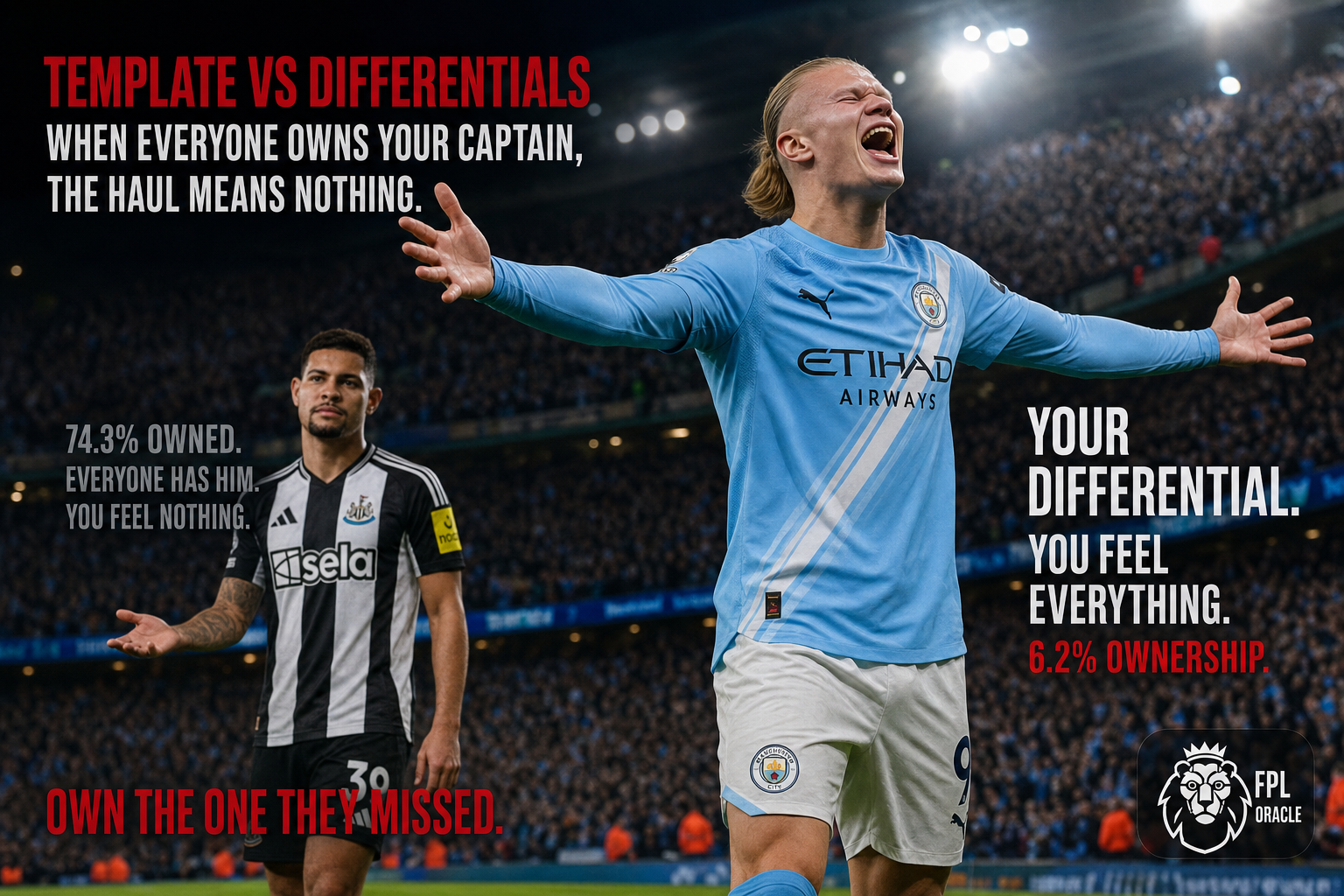
At some point in every FPL season, you find yourself staring at a squad that looks almost identical to the top 10k average. Six or seven template players. A popular premium captain. Safe, sensible, defensible. And yet your rank refuses to move. This is the template trap — and it is not a myth, it is a mathematical reality. When most of the game owns the same players, captains the same names, and takes the same hits, outcomes converge. Rank is zero-sum: you can only rise by performing better than others, and you cannot do that if you are making the same decisions. This guide breaks down exactly what the effective ownership data says about the template, when it makes sense to follow it, and the specific conditions under which a well-chosen differential is the higher-EV play.
What Is the FPL Template — and Who Defines It?
The FPL template is the set of players held by a high proportion of the most informed managers in the game. It is not the same as the most-owned players across all 11 million entrants — it is specifically what the top 10k–100k managers tend to converge on, driven by expected points models, underlying stats, and fixture analysis rather than reputation or media coverage.
Template players typically share several traits: strong expected goals involvement (xGI), good upcoming fixtures, premium price tags that reflect their ceiling, and ownership concentrated among higher-ranked managers who drive the statistical consensus. When managers talk about the template, they mean players like a top-end midfielder with consistent xGI of 0.5+ per 90 over the last six gameweeks who is owned by 40–60% of the top 10k. Owning this player feels safe — because the most analytical managers in the game all own him too.
But here is the key insight: owning the same players as other smart managers does not make you rank against them. FPL's scoring is purely points-based — and when two managers own the same players, both get the same points from them. Your relative rank versus those managers is determined entirely by the players you do NOT share. The template neutralises you against the most informed cohort. The differential is where you either win or lose against them.
The EO Math: What Happens When Everyone Owns the Same Player
Let us run the numbers on a template captain scenario. Take a midfielder with 55% overall ownership and a 65% captain rate among those owners. His effective ownership (EO) is approximately 55% + (55% × 65%) = 91%. Over 90% of active managers are riding his score at full weight.
Scenario A: he hauls — scores 2 goals and an assist for 18 points (36 with captain multiplier). You gain 36 points. So does 91% of the game. Your rank movement versus those managers? Zero. You might green arrow against the 9% who blanked him or captained someone else — but against the informed cohort, you barely moved.
Scenario B: he blanks — 2 points (4 with captain). You lose 4 points on the week. So does 91% of the game. Again, zero rank movement versus the field. You might actually red arrow against anyone who went to a differential captain who delivered.
This is the mathematical reality of template captaincy at high EO: the haul is not as valuable as it feels, and the blank is less damaging than it feels — but across a season, you are generating very little rank-movement alpha. You are tracking the field, not beating it. As we explain in detail in our effective ownership guide, the rank movement from any single decision is proportional to how different that decision is from what the field is doing.
The Case FOR the Template — When It Makes Mathematical Sense
Before dismissing the template, it is important to be precise about when following it IS the correct play.
When you are protecting a high rank near the season's end. If you are sitting in the top 10k with four gameweeks to go, going with the field is correct — you are not trying to gain 50k rank positions, you are trying not to lose 5k. The template is a variance-reduction strategy. When your goal is stability rather than gains, it delivers exactly what it promises.
When the template player is genuinely the highest expected-points pick by a clear margin. If the consensus exists because the data is overwhelming — a striker with four home games in the next five gameweeks, facing the three worst defences in the league, with double-figure xG in the last eight matches — then the template exists for good reason. Following it is not sheep behaviour; it is reading the same data correctly.
When your team structure requires a specific player type and the template player in that position is clearly best. If you need a sub-£8m midfielder and the template choice has significantly better underlying stats than any alternative, the template IS the high-EV pick. The argument against the template only applies when there are genuine alternatives with comparable or better expected output at lower EO.
The template is not your enemy. Blindly following it without understanding its EO implications is.
The Case FOR Differentials — The EO Asymmetry
Now let us look at the other side of the ledger. A player with 12% ownership and 70% captain rate among those owners has an EO of roughly 20%. 80% of the game has no exposure to his score. If he hauls — let us say 14 points (28 with captain) — you gain 28 points against 80% of the field who scored 0 from that slot. That is a massive green arrow against the majority of managers in a single gameweek.
This is the asymmetric upside of the differential: when it lands, the rank gain is disproportionate because so few people share it. The downside is symmetric — if he blanks, you lose rank to the 80% who went elsewhere. But critically, the expected frequency of the blank is the same for your differential as for the template player. What changes is the rank reward when you are right.
The mathematical case for differentials rests on three conditions: (a) the player has a genuine haul route — not just low ownership, but real expected points to back it; (b) your rank situation calls for upside rather than stability; and (c) the EO difference between your differential and the template pick is large enough to justify the variance.
Condition (a) is the most violated. Too many managers take differentials based on narrative — "he's due a big one", "his fixtures are great", "the manager loves him". None of that is quantified. A differential without supporting underlying stats (xG, xA, xGI, shots in the box, penalty area touches) is just a punt. The differential edge comes from finding players whose expected output is under-priced by the market, not from going low-ownership for its own sake.
A wildcard is the cheapest moment in the season to take one, because you are rebuilding everything at once and a single miss does not strand you. When to play it covers the timing.
The Rank-Tier Decision Framework
The right balance between template and differential is not static — it changes based on your current rank, your rank ambition, and the time remaining in the season. Here is how to calibrate it:
Rank 1M+, large gap to close: You need significant upside. A high proportion of differential picks — especially at captain — is mathematically necessary. Going with the template every week almost guarantees you finish where you started. Target EO below 40% for your captain more often than not, and look for template alternatives at every price point where the underlying stats are comparable.
Rank 200k–1M, chasing top 100k: This is the most common ambition zone and the trickiest. You need a mix: template ownership in your squad (to avoid catastrophic blank weeks), but differential captaincy when the EO math creates enough asymmetry. A useful rule: if the top captain pick has EO above 70% and a player with EO below 35% has expected points within 2 of the favourite, consider the differential. The rank upside on a haul compensates for the increased variance.
Rank 50k–200k, consolidating top 100k position: Weight slightly more toward the template in ownership, but still look for captaincy differentials when they appear. You have something to protect but also ground to gain. The sweet spot is template squad structure with 1–2 differential picks in your starting XI who carry independent haul potential.
Rank sub-50k, season end: Track the field. Your differentials should be minimal and your captain should closely track the highest-EO pick that also has the best expected points. The goal here is zero variance from the consensus, not alpha generation.
For a deeper look at how rank ambition should reshape every aspect of your decision-making — not just captaincy — our rank protection vs rank climbing guide maps the full framework by rank tier.
The cheapest differentials this season are defensive, because DefCon gave the position a floor and there are far more sub-£5.0m defenders than forwards. Our formation guide covers what that does to your starting shape.
The "Template-But-Different-Captain" Hybrid
One of the most effective strategies that sits between pure template and pure differential is what you might call the hybrid play: own the template players in your squad but captain a differential. This gives you floor protection (your template players deliver even if the captain blanks) while creating captaincy upside against the 80%+ of the game who captain the obvious pick.
This approach works because it separates two different decisions that managers often conflate: the squad composition decision (template vs differential in your XI) and the captain decision (high EO vs low EO). You can own the template players without also captaining the highest-EO player in the game. The two decisions are independent, and treating them as independent opens up far more strategic options.
The practical implementation: build a squad that is 60–70% template (protecting your floor by avoiding catastrophic blank weeks where the whole template hauls and you miss) but deliberately seek one or two under-owned players with genuine upside. Captain from that pool, not from the template. If your differential captain lands, you gain rank on both the people who blank him AND the people who captain the template player without your differential's bonus. If he does not, your template ownership protects you from a catastrophic week.
The template tells you who is good. Effective ownership tells you how much that goodness is already priced in to the rank movement. The differential edge is not about owning bad players — it is about finding good players that the market has not yet priced correctly.
Common Differential Mistakes to Avoid
Going differential for the wrong reasons is worse than going template, because you get all the variance with none of the expected-value advantage. The most common mistakes:
Ownership as a reason in itself. "He's only 8% owned" is not a reason to captain someone. Low ownership plus low expected points is a bad punt. Low ownership plus high expected points that the market has missed is genuine differential alpha.
Narrative-driven differentials. "He played really well last week" is not an underlying stat. Shot counts, expected goals, penalty area involvement, and set piece status are. Use tools like Understat's xG data to verify that the underlying metrics support the narrative before committing.
Differentials in the wrong position. A differential forward who returns 1-in-4 is far less valuable than a differential midfielder who returns 1-in-3, because the midfielder's ceiling per haul is usually higher (goals + assists vs assists only for most forwards who are not penalty takers).
Taking differentials when you should be tracking. If you are top 8k with three gameweeks to go, chasing a differential captain is not brave — it is strategically incorrect. Know your rank situation and calibrate accordingly.
The pattern shows up clearly at a single position. Fernandes, owned by roughly half the game, is the template pick at his price point — captaining him is closer to tracking the field than beating it. E.Le Fée, a similarly-priced midfielder owned by under 2% of the game with comparable underlying form, is the differential case: similar output, completely different rank exposure. Neither is a standing recommendation — the point is the EO gap between two players doing similar jobs at a similar price, which is the actual decision variable. For how this same gap should change your captaincy choice specifically, see our full captaincy framework.
The cheapest way to avoid most of these is to take differentials from a club entering a good run rather than leaving one. Our GW6–GW10 fixture breakdown shows which clubs those are.
The Oracle Takeaway
The template vs differential debate resolves to a single principle: the template is the right default only when the EO math does not create enough asymmetry to justify variance. When it does, the differential is not speculation — it is the higher expected-value play.
Four actions to take from this framework: First, stop conflating "safe" with "high EV" — at high EO, the template captain is actually a low-EV rank decision. Second, always calculate EO before your captaincy call, not just ownership. Third, calibrate your differential tolerance to your rank ambition — more variance needed means more differential exposure. Fourth, use the hybrid approach: template squad, differential captain. It is the best-of-both-worlds structure for most of the season.
FPL Oracle applies this framework automatically. When you share your squad and ask about captaincy, Oracle calculates the EO distribution across your picks, identifies where the asymmetric rank upside sits, and gives you a recommendation that is calibrated to your specific rank situation — not just a list of the most popular players. See how Oracle handles your captaincy decision this week — enter your manager ID and ask it directly. The analysis takes seconds.
Right now, how much of your squad is pure template vs genuine differential picks? Be honest — do you actually know your EO exposure heading into this week's deadline? 👇