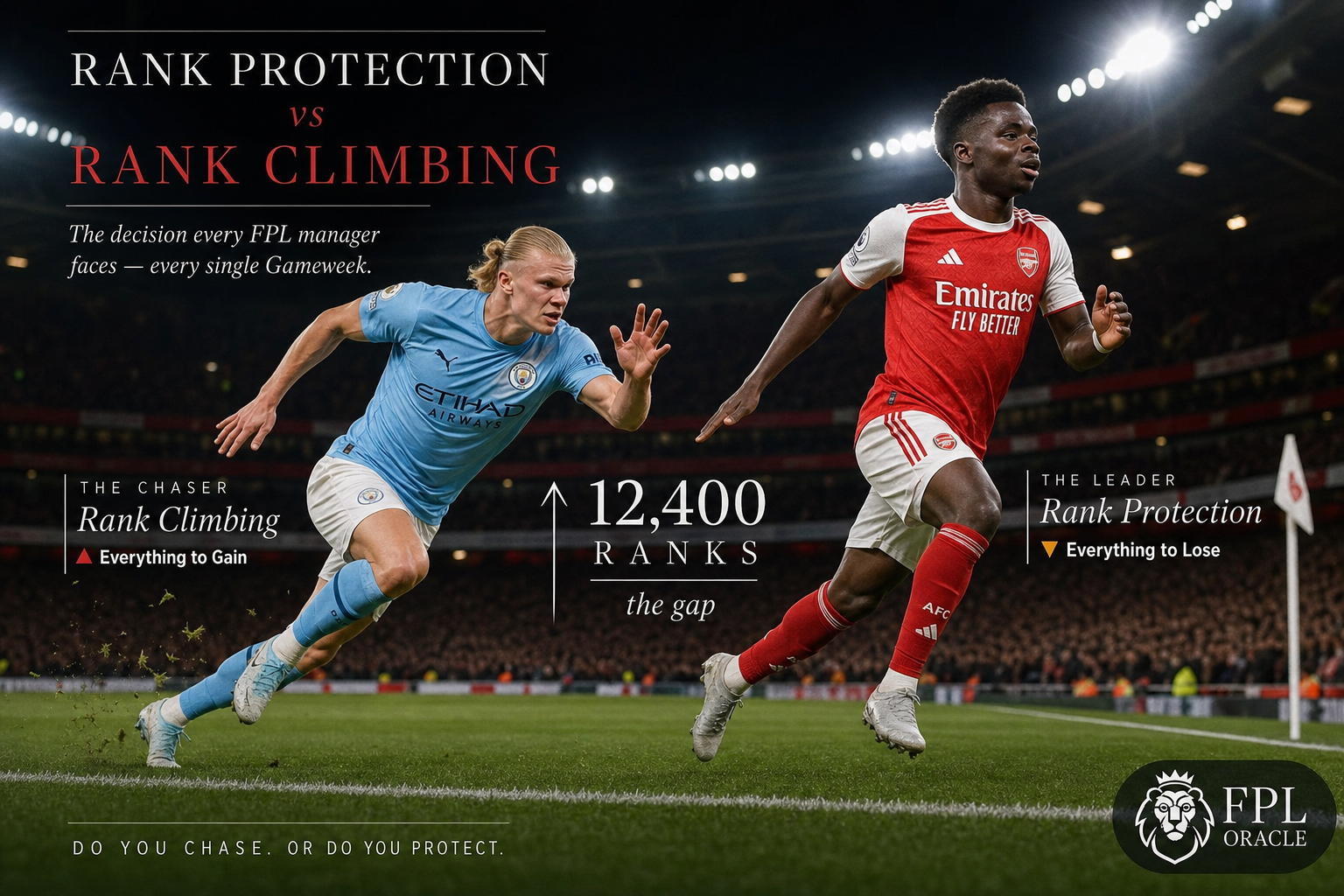
Here is a mistake that costs FPL managers thousands of rank positions every season: playing the exact same game at rank 800,000 that they play at rank 50,000. The decisions that make sense when you are protecting a hard-earned position are completely different to the ones that make sense when you need to climb. A captain pick that is correct at rank 8k is wrong at rank 800k. A transfer that is sensible when you are consolidating can be rank-neutral at best when you need asymmetric upside. FPL rewards managers who understand that the optimal strategy is not static — it changes based on where you are, where you want to be, and how much of the season remains. This guide gives you a full framework for calibrating every major FPL decision to your rank situation, from the opening gameweeks to the final push.
Why Your Rank Position Is a Strategic Variable, Not Just a Number
FPL is a rank-ordered competition. The game awards prizes and bragging rights based on where you finish relative to all other managers — not on your absolute points total. This has a profound implication: the correct decision is not the one that maximises expected points in isolation, but the one that maximises expected rank position given where you currently sit.
These two objectives — maximising expected points and maximising expected rank — diverge significantly depending on your position. If you are rank 800k and the rest of the game is averaging 50 points per gameweek, you need to score above average to climb. Going with the template means your score tracks the field — you gain no rank on the managers around you. If you are rank 8k and the rest of the top 10k is averaging 52 points, you need to match that just to stay where you are. A differential that blanks costs you more rank than a template pick that underperforms.
The mathematical framework is simple: rank climbing requires above-average outcomes relative to your target rank tier, which requires decision differentiation from that tier. Rank protection requires matching the field, which requires decision convergence with that tier. The implication is that your captain, transfer, and chip decisions should all be oriented differently depending on which mode you are in.
The Four Rank Modes
Rather than a continuous spectrum, FPL managers tend to operate in one of four distinct strategic modes at any given point in the season. Understanding which mode you are in — and when to switch — is the core of rank-intelligent FPL.
Mode 1 is Rank Climbing Aggressively, for managers at rank 500k or above, or in any rank early in the season. Your primary objective is to gain as much ground as possible. Your decisions should maximise expected upside rather than minimise variance. Captain from lower effective-ownership picks with genuine haul potential. As explored in our effective ownership guide, captaining a player with EO below 35 percent means 65 percent or more of managers gain no rank from your haul. Take proactive transfer hits when the expected return justifies the cost over 2 to 3 gameweeks. Use chips early and boldly — the second chip set is coming.
Mode 2 is Rank Climbing Steadily, for managers at rank 100k to 500k in mid-season. You have meaningful ground to gain but also something to protect. The right approach is a hybrid squad structure: 60 to 70 percent template players to protect your floor, with 2 to 3 picks carrying genuine upside who are not widely owned in your rank tier. Captain from the differential pool when the EO math creates enough asymmetry.
Mode 3 is Rank Consolidation, for managers at rank 20k to 100k in the second half of the season. Your primary objective shifts from gaining rank to not losing it. The high-EO captain is now significantly more justified — if the template captain hauls, you keep pace with your competition tier. If he blanks, so do most of your peers. Make conservative transfers that prioritise form and fixture predictability over upside.
Mode 4 is Rank Protection Tight, for managers at rank 1k to 20k in the last 6 gameweeks. You are in elite territory and the margin for error is minimal. The captain should almost always be the highest-EO pick with the best expected points. Transfers should be made only when they clearly strengthen expected points. Chip timing must be conservative. For the benchmarks around what rank positions require in terms of points, our FPL rank percentile guide gives a full breakdown of what the top 10k, top 50k, and top 100k thresholds typically look like.
Chip Timing Through a Rank Lens
Chip decisions are the highest-leverage moments in the FPL season — and they are the decisions most clearly affected by rank mode. The new 2025/26 two-of-each chip system changes the calculus significantly, because you have more flexibility and less urgency around any single chip.
In climbing aggressively mode, use chips early and boldly. A Triple Captain on a premium asset in a favourable gameweek used at rank 700k can gain you 100k rank positions in one week if it lands. The variance is acceptable because the downside is a much smaller proportional cost at rank 700k than at rank 15k. In climbing steadily mode, save chips for gameweeks with genuine structural advantages — double gameweeks, or a run of matches where your premium assets face very weak opposition. In consolidation and protection modes, chip timing becomes extremely important. The wrong gameweek for a Bench Boost at rank 30k can cost you 20k positions. The full chip timing framework for 2025/26 is covered in our complete guide to the new chip system.
The wildcard is where this bites first, since it is the chip most managers spend on instinct rather than on rank mode. Our wildcard timing guide covers the trigger, including why a bad gameweek is not one.
The Transfer Calculus: Hits, Rolls, and Rank Mode
Transfer strategy is the second-biggest lever after captaincy, and it is rank-mode dependent in ways most managers overlook. The question of whether a minus-4 hit is worth it has no universal answer — but rank mode gives you the framework to answer it for your specific situation.
In climbing mode at rank 500k or above, the calculus tilts toward taking hits proactively. If the incoming player is expected to return 6 points more than the outgoing player over the next three gameweeks, the hit breaks even immediately and creates upside. More importantly, the rank gain from a proactive transfer that lands is disproportionate — you own a player others do not yet have, in his best fixture run.
In protection mode at rank sub-20k, the calculus inverts. A minus-4 hit creates guaranteed rank loss against the managers in your peer group who rolled. If the transfer does not immediately return significant points in the next 2 gameweeks, you have lost rank for nothing. The break-even point for a hit in protection mode is higher, because the opportunity cost of the 4 points is much larger when you are competing against a small, high-performing cohort. For the full analysis of when template vs differential thinking should govern your transfer decisions, the framework is covered in detail in our template vs differential decision guide.
One input that should never enter this calculation is team value. Taking a hit to beat a price rise trades 4 guaranteed points for roughly £0.05m of spending power — the maths is set out in full here.
Mini-League Mode: A Special Case
Overall rank strategy and mini-league strategy are related but distinct — and you may need to run two different strategic calculations simultaneously. Your overall rank mode determines your broad approach. Your mini-league situation may create a short-term override.
If you are 50 points behind the leader in your mini-league with 6 gameweeks remaining, you need to climb in the mini-league specifically. The relevant effective ownership is not the gamewide EO of your captain pick, but the EO within your mini-league. If 14 of your 20 mini-league rivals own the template captain, his EO within your competition set is high and captaining him gives you no mini-league upside on a haul. A differential captain who lands gains you rank against those 14 managers simultaneously.
The mini-league override works for 3 to 4 gameweeks maximum. Mini-league strategy that ignores overall rank for longer tends to create unforced errors that cost you both.
Mini-league mode only works if you can actually see your rivals' squads, and every tool that shows you them asks for a league ID first. Here's where that number lives.
The Season Arc: When to Switch Modes
Most managers experience multiple mode transitions across a season. In GW1 to GW10, almost everyone is in climbing mode regardless of starting rank — early-season variance is high and there is plenty of time to recover. Be proactive and take risks when the expected value supports it. In GW11 to GW20, the field starts to stratify. If you are in the top 50k by GW15, start thinking about consolidation mode. If you are below 200k and want top 100k, stay in climbing mode with urgency. In GW21 to GW30, the double gameweek and chip windows concentrate. Identify your mode going into this period and plan chip usage accordingly. In GW31 to GW38, protection mode becomes relevant for anyone in the top 50k. Climbing managers have fewer gameweeks to generate upside, which means each decision carries more weight because there are fewer opportunities to recover from a mistake.
The manager who plays FPL the same way all season, regardless of rank, is leaving the game's most powerful lever untouched. Your rank position is not just a score — it is a strategic input that should reshape every captain pick, every transfer decision, and every chip timing call you make from the moment you look at it.
The posture shift is visible in real picks. A protecting manager sitting comfortably in the top 50k has every reason to track a heavily-owned template pick like Saka — the downside of missing a rare blank is small relative to the downside of a contrarian miss. A climbing manager with real ground to make up has the opposite calculus: a player like Gibbs-White, priced well below the premiums and owned by under 10% of the game, is exactly the kind of asymmetric bet a protecting manager has no reason to take but a climbing manager often should.
The Oracle Takeaway
Rank-intelligent FPL is the difference between a manager who plays the same game all season and one who adapts to their position. The framework is simple: know your mode, and calibrate captaincy, transfers, and chip timing to that mode consistently.
Four immediate actions: Identify which of the four modes you are currently in based on your rank, your ambition, and the weeks remaining — write it down, it grounds every decision. Check your captain approach against your mode — are you taking enough risk if you are climbing, or too much if you are protecting? Review your pending transfer plans through the mode lens — is this a proactive hit that climbing requires, or a speculative punt that protection mode cannot absorb? Map your chip plan to upcoming gameweeks against your mode — chips in climbing mode should target bold moments, chips in protection mode should target certainty.
FPL Oracle builds your rank situation directly into every recommendation it makes. When you ask Oracle about captaincy, transfers, or chip timing, it does not give a generic answer — it accounts for your overall rank, your mini-league position, and the gameweeks remaining to calibrate the advice to exactly where you are and what you need. Tell FPL Oracle your rank and ambition and get recommendations that are actually matched to your strategic position, not just what the consensus is doing.
What mode are you in right now — genuinely climbing, consolidating, or protecting? And is the way you are actually playing matching up with what that mode demands? 👇