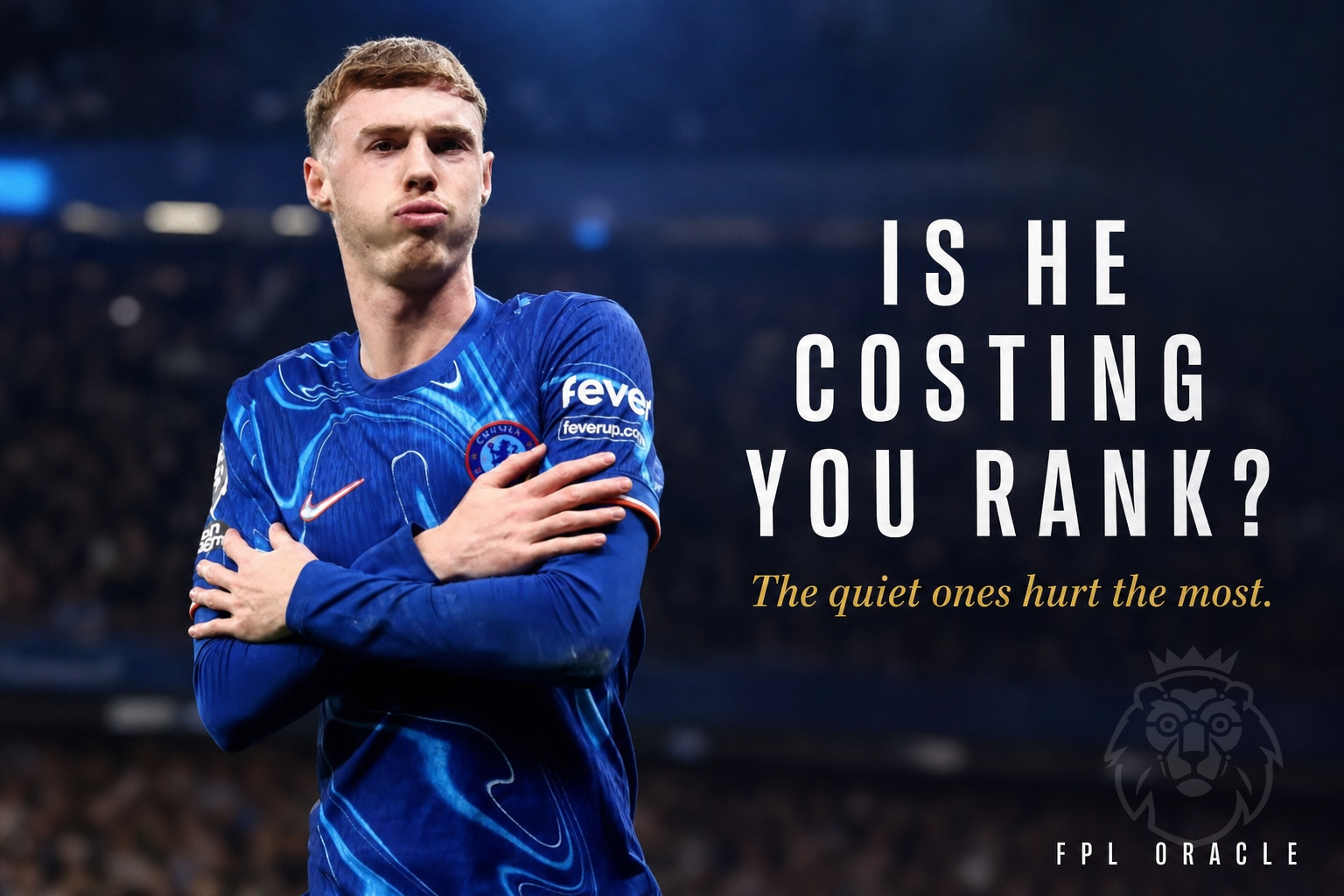
Not every rank-damaging decision in FPL announces itself. A blank captain gameweek is obvious — you feel it immediately. But the slower, quieter damage comes from a different source: a player sitting in your squad who is not blanking exactly, but is consistently underperforming his price point and his ownership level, week after week, invisibly costing you rank relative to managers who moved on from him weeks ago. This guide is about identifying that player — or players — in your specific squad right now, and understanding the mechanism by which they are actually damaging your rank even when their scores don't look catastrophic on paper.
The Invisible Rank Cost: Opportunity Cost, Not Blank Score
The most common mistake managers make when reviewing their own squad is looking at each player's raw point total and asking "is this bad?" A player who has returned 25 points over 6 gameweeks does not look disastrous in isolation. But the correct question is not whether the score is bad — it is whether that price slot could be generating meaningfully more points elsewhere, and whether the rest of the game has already made that switch.
This is opportunity cost, and it is the primary mechanism by which a mediocre-but-not-terrible player damages your rank. If a £7.5m midfielder has returned 25 points over 6 gameweeks while a similarly priced alternative has returned 40, you have not "lost" 15 points in an obvious sense — your player did play, did contribute. But relative to the field, and specifically relative to managers who made the swap three gameweeks ago, you are 15 points behind on that single slot, compounding weekly.
The Three Signals of a Rank-Damaging Player
Signal 1 — Falling ownership with no corresponding role change. If a player's ownership has been steadily declining over 3 to 4 gameweeks, the market is telling you something. It does not automatically mean you must sell — sometimes the market overreacts — but it is a signal worth investigating. Check whether his underlying stats (xGI, shots in the box, minutes) have genuinely declined, or whether the ownership drop is driven by narrative rather than data. If the underlying numbers have also fallen, the ownership signal is confirmed and the rank damage is compounding.
Signal 2 — Price falling while your rival's equivalent slot is rising. A price drop reflects the game's collective transfer activity. If your £8m midfielder is dropping in price while a positional alternative at the same price is rising, that is the clearest possible signal that the field has already made the swap you have not. Every gameweek this persists, the rank gap it represents grows.
Signal 3 — Effective ownership divergence from your captaincy pattern. This connects directly to the framework in our effective ownership guide. If you are still captaining or vice-captaining a player whose effective ownership has fallen well below the top 2 to 3 candidates in your squad, you may be carrying a captaincy habit that is no longer supported by the current EO picture — costing you specifically at the moment your points are doubled.
Why This Is Hard to Spot From Inside Your Own Squad
There is a well-documented bias in FPL (and in most fantasy sports): managers are systematically slower to identify underperformance in players they already own than in players they do not. Sunk cost, prior conviction, and simple familiarity all work against an objective read of your own squad. You watched this player's good performances earlier in the season and that memory anchors your expectation, even after the underlying data has shifted.
This is precisely why an external, data-driven view of your specific squad is more useful than another round of self-assessment. It is not that you are bad at FPL — it is that everyone is worse at evaluating their own existing squad than they are at evaluating a hypothetical transfer target with fresh eyes.
The same blind spot applies to your mini-league, where the comparison that matters is against specific people rather than the overall field. That needs your league ID — here's how to find it.
How to Actually Quantify the Damage
The most useful way to think about a potentially rank-damaging player is not "is he good or bad" but "what is his rank impact score relative to the field's alternatives at his price." This combines three inputs: his recent expected points versus his actual returns (is he underperforming his own underlying data, or is the data itself weak), his price-tier alternatives' recent output (is there a genuinely better option at a similar cost), and his ownership trajectory relative to those alternatives (has the field already made this swap).
FPL Oracle's Rank Impact Analyser runs exactly this calculation against your actual squad — surfacing, player by player, which of your 15 are quietly protecting your rank (outperforming their price-tier alternatives) and which are quietly costing you ground relative to the field, updated with each gameweek's data rather than requiring you to run the comparison manually.
What to Do Once You've Identified the Culprit
Identifying a rank-damaging player does not automatically mean an immediate transfer. Apply the same rank-mode framework covered in our rank protection vs rank climbing guide: if you are in a climbing mode and have a free transfer available, moving off a confirmed rank-damaging asset is close to a free rank improvement. If you are protecting a strong rank and would need to take a hit to make the move, weigh the guaranteed 4-point cost against the ongoing weekly opportunity cost of keeping him — often, if the gap has been building for 3 or more gameweeks, the hit pays for itself quickly.
Also check whether the player in question is a captaincy habit rather than a squad slot problem. Sometimes the fix is not a transfer at all — it is simply moving the armband to a teammate with a better current case, using the process outlined in our full captaincy decision framework.
The most expensive mistake in FPL is rarely a single bad transfer. It is a mediocre player left in your squad for six gameweeks too long, quietly bleeding rank in the background while you focus on your next transfer target instead of your current weak link.
The shield/threat split plays out with real squads every week. A heavily-owned, high-output player like Haaland or Fernandes is a genuine shield if you own him — the rest of the game rises and falls with you. The threat side looks different: a template pick you don't own, like Saka or Palmer, is quietly costing you rank every gameweek he outperforms your XI, whether or not you've noticed the gap yet.
A falling price is usually the market reaching the same conclusion a few days after you did. It's a confirmation signal rather than a reason to sell — we cover the difference here, along with why panic-selling a good player to dodge £0.2m costs more than it saves.
The Oracle Takeaway
Rank damage from an underperforming-but-not-blanking player is invisible on a weekly points screen and only becomes obvious in hindsight, once the rank gap has already compounded. The fix is proactive review, not retrospective regret: check ownership trajectory, price movement relative to positional alternatives, and effective ownership alignment with your captaincy pattern, regularly rather than only after a visibly bad gameweek.
Three actions to take today: review your squad for any player with 3-plus consecutive gameweeks of falling ownership and confirm whether the underlying stats support the market's move away from him. Check whether your current captaincy pattern is still aligned with the EO leader in your squad or has become a habit disconnected from the current picture. And if you identify a genuine rank-damaging asset, run the transfer math against your current rank mode before deciding whether the hit is worth it.
FPL Oracle's Rank Impact Analyser runs this exact audit against your real squad automatically, surfacing which players are protecting your rank and which are quietly costing you ground — no manual cross-referencing required. Check your squad's rank impact with FPL Oracle and find out who's actually helping and who's holding you back.
Be honest — is there a player in your squad right now you already suspect is costing you rank but haven't pulled the trigger on yet? 👇