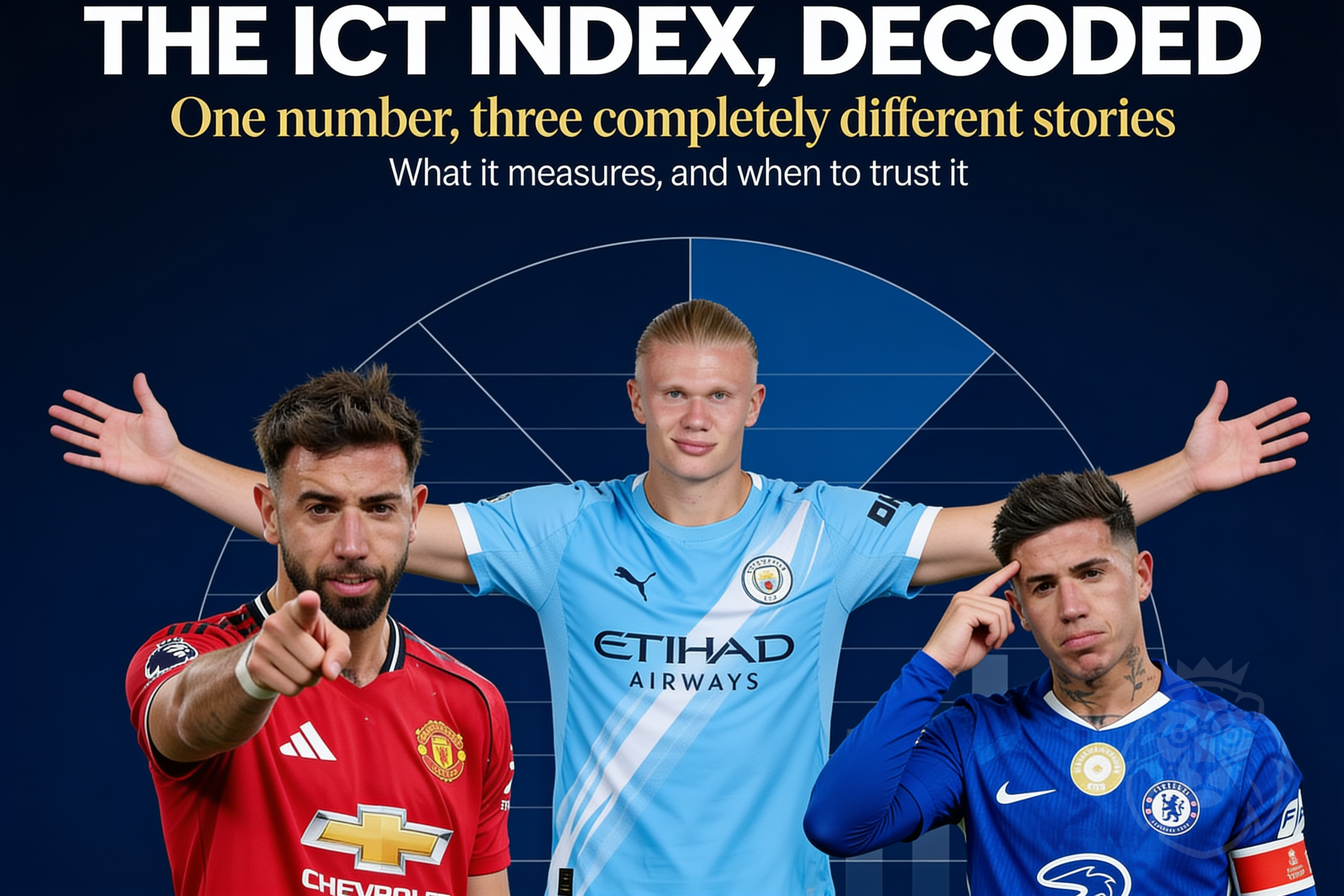
The ICT Index shows up on every player's FPL page as a single tidy number, and most managers glance at it, note whether it is high or low, and move on. That single-number treatment throws away most of the useful information the stat actually contains. ICT is a composite — three separate underlying metrics blended into one figure — and two players can land on an almost identical headline number through completely different routes. Knowing which route a player took changes what the number actually tells you about him, and specifically which FPL decision he suits: a captaincy pick built on raw threat, or a creative asset better suited to assist-hunting in your midfield.
What ICT Actually Stands For
According to the official FPL rules, the ICT Index is built from three component scores: Influence, Creativity, and Threat, combined into a single index intended to help identify standout performers. Influence measures a player's overall effect on a match — actions that shape the game beyond just goals and assists, including defensive actions and general involvement in significant match events. Creativity measures a player's rate of chance creation for teammates — the passing and movement patterns that lead to scoring opportunities for others. Threat measures a player's likelihood of scoring, based on the frequency and quality of his own goal-scoring positions and attempts.
The final ICT Index score is a blend of all three, which is exactly why the single number can be misleading in isolation. A player can arrive at a high ICT score almost entirely through Threat, almost entirely through Creativity, or through a genuinely balanced contribution across all three components — and those are three very different player profiles wearing the same headline number.
Why Two Players Can Share an ICT Score for Opposite Reasons
This is best illustrated with two players currently sitting near the top of the league-wide ICT rankings. Fernandes currently leads the league in ICT Index at 381.4, and his score is overwhelmingly driven by Creativity and Influence — the profile of a deep-lying playmaker involved in build-up, set pieces, and chance creation throughout a match, rather than a player whose primary job is finishing chances himself. Haaland sits second at 302.3, but his score is built almost entirely through Threat — the number reflects a player whose value comes overwhelmingly from getting into scoring positions and shooting, with comparatively little contribution from the Creativity or Influence components.
These two players are separated by less than 80 points on a single composite scale, which might suggest similar overall value. But they are not remotely similar assets, and the ICT number alone does not tell you that — you have to look at the component breakdown to see it. A third example, Enzo, sitting third at 264.6, adds a further useful comparison point: a box-to-box midfielder profile where the score is spread more evenly across all three components rather than concentrated in one, which is itself a distinct and useful signal about how reliably repeatable his contribution is likely to be.
Why the Decomposition Matters for Squad Decisions
The practical reason to look past the headline number: Threat-driven ICT and Creativity-driven ICT behave differently and suit different roles in your squad. A Threat-heavy player's FPL output is concentrated almost entirely in goals — his ICT score is essentially telling you how often he is shooting from good positions, which correlates closely with goalscoring output and, by extension, captaincy upside on a week where the underlying volume shows up as an actual goal.
A Creativity-heavy player's ICT score correlates more closely with assist output and, under the DefCon-adjacent scoring changes of recent seasons, potentially with broader involvement in general play. This matters specifically for captaincy decisions, where the doubling effect rewards high, spiky ceiling output — a Threat-driven player's ICT profile is arguably a slightly better raw captaincy signal than an equally-scored Creativity-driven player's, because goals are a more reliable single-event points source than assists, which depend on someone else finishing the chance he creates.
ICT Index Rank vs Raw Score: Which One to Use
The raw ICT number is only meaningful in the context of where it sits relative to the rest of the league, since the scale itself is not intuitive in isolation — a score of 264.6 tells you nothing on its own without knowing that it currently places Enzo third league-wide. Always check the rank alongside the raw score, not the raw score in isolation. A player whose ICT rank has been climbing over the last several gameweeks, even if his absolute score is still modest relative to the league's very top performers, is a signal worth investigating — it often precedes a rise in actual returns before the wider market has fully adjusted his ownership or price.
Where ICT Fits Alongside xGI
ICT and xGI, covered in full in our xG, xA and xGI explainer, are complementary rather than redundant. xGI is specifically about goal-scoring and chance-creation quality — a narrower, more targeted metric. ICT is broader, folding in general match influence alongside the attacking components, which makes it useful for catching players whose overall value is not fully captured by attacking output alone — a deep-lying midfielder who influences the game heavily without racking up huge underlying attacking numbers, for instance.
The practical rule: use xGI when your question is specifically about goal threat or chance creation for a transfer or captaincy decision. Use the ICT breakdown when you want a broader read on a player's overall involvement and influence, particularly for evaluating a player whose FPL value might not be obvious from goals and assists alone.
The Influence component in particular overlaps heavily with what actually drives a player's bonus points — see our breakdown of how FPL bonus points really work for the full picture of which specific actions convert general match influence into actual bonus points awarded after the match.
Using ICT in Your Captaincy Process
Within the full captaincy framework covered in our complete captaincy decision guide, ICT's Threat component specifically is a useful cross-check against your xGI-based captaincy shortlist. If a candidate's Threat score and his xG are telling the same story — both pointing to strong, sustained goal-scoring opportunity — that convergence increases your confidence in the pick. If they diverge significantly, it is worth investigating why before committing the armband, since a mismatch between the two data sources often indicates something one metric is capturing that the other is not (a change in shot location, for instance, or a shift in who is taking penalties).
The ICT Index is not one stat. It's three stats wearing a single number's clothing. Decompose it before you trust it, because a Threat-driven 300 and a Creativity-driven 300 are telling you to make two completely different FPL decisions.
The Oracle Takeaway
The ICT Index is most useful when you resist the temptation to read it as a single verdict. Break it into its Influence, Creativity, and Threat components before applying it to a transfer or captaincy decision, since two players can share a nearly identical headline score while representing completely different profiles suited to completely different roles in your squad.
Three actions to take this week: check the component breakdown, not just the headline number, for any player you are evaluating. Use Threat specifically as a captaincy cross-check against xGI-based shortlists, since goal-scoring is a more reliable single-event points source than creativity-driven output. And track ICT rank movement over the last few gameweeks, not just the current absolute score, since a rising rank often precedes a rise in actual returns.
Every player page on FPL Oracle shows both the ICT Index and its live league-wide rank directly, alongside the component breakdown. Check any player's ICT breakdown on the Player Hub, or ask FPL Oracle to decompose a specific captaincy shortlist by Threat and Creativity before your next deadline.
Have you ever picked a player based on a strong ICT score, only to realise afterward the number was built from a component that didn't actually suit what you needed him for? 👇