There is a moment in every FPL season, usually somewhere between Gameweek 4 and Gameweek 8, when you open your team and think: this is broken. Three players flagged, two who never start, and a bench you'd rather field than your first eleven. The wildcard is right there. It costs nothing to use.
That feeling is the single most expensive thing in Fantasy Premier League, because it is almost never the right trigger. Here is when to actually play your first wildcard, when to sit on it, and the one calculation that settles it.
The Real Question Isn't "Is My Team Bad"
Every manager who wildcards early does it for the same reason: the squad looks wrong. But "looks wrong" is a feeling about eleven names on a screen, and a wildcard is a tool for fixing a structural problem. Those are different things.
The useful question is not whether your team is bad. It is how many moves behind the squad you actually want are you. A team can look terrible and be two transfers from fine. A team can look acceptable and be six transfers from anything you'd want to own in November.
The Four-Transfer Test
Here is the whole decision, and it takes about two minutes.
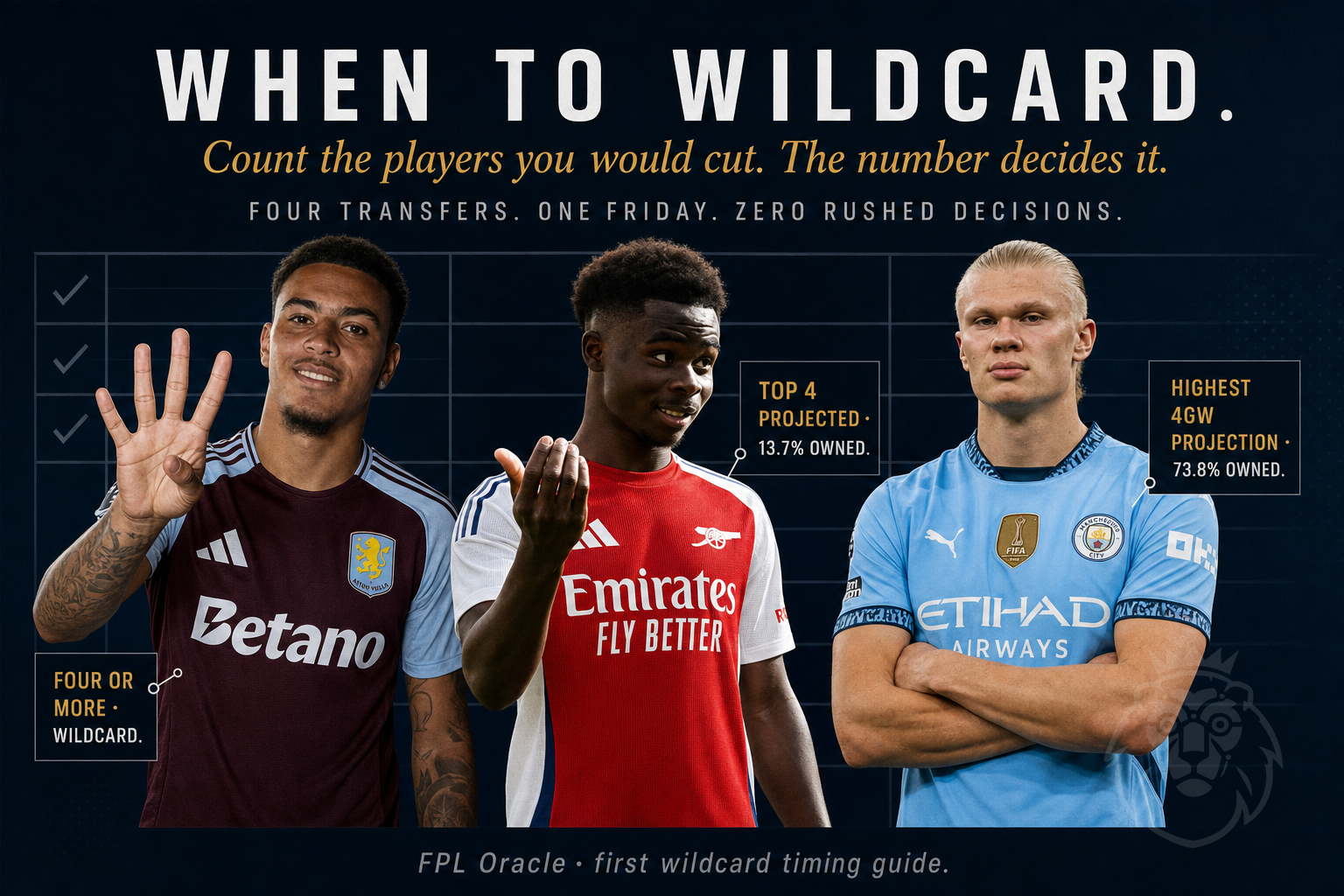
Write down the players you would remove if there were no cost at all. Not the ones you're annoyed with — the ones who genuinely will not be in your team in three gameweeks' time. Count them.
| Players you'd cut | What to do |
|---|---|
| 1–2 | Use your free transfers. You do not have a wildcard problem, you have a Tuesday afternoon. |
| 3 | Borderline. Two weeks of free transfers fixes it. Only wildcard if the fixtures demand it now. |
| 4+ | Wildcard. Doing this with transfers means either four weeks of patching or a string of hits. |
The hard part is being honest about that list, because the players you're annoyed with and the players who are actually costing you are rarely the same. Our guide to the players quietly wrecking your rank covers how to tell them apart — a popular player you don't own can hurt you more than a bad one you do.
Four is the line because that's where the arithmetic flips. Fixing four players with free transfers takes a month, during which you own the problem you identified. Fixing them with hits costs 12 points or more, which is most of a gameweek. At four, the wildcard is simply the cheapest route — and below four, it is a chip spent on something a bit of patience would have solved.
If a hit is what you're weighing instead, our expected-value framework for taking a hit covers when −4 is worth paying.
You Have Until Gameweek 19, and That Matters
Your first wildcard is not open-ended. FPL runs two chip windows, and the first wildcard is available from Gameweek 2 to Gameweek 19. It does not roll over. Unused at the Gameweek 19 deadline, it is gone, and a second, separate wildcard becomes available for Gameweek 20 to 38.
That cuts both ways, and most advice only gives you one side of it.
It means there is no prize for hoarding. A wildcard still sitting in your account in December has done nothing for you, and the manager who used theirs in October has had three months of a better squad. But it also means you have weeks of room. The pressure you feel in a quiet international break to do something right now is manufactured — you have until Gameweek 19, and the fixtures between now and then will tell you far more than your current frustration does.
Where you sit in the rank table should also shape the timing. A manager protecting a strong rank and one chasing from 2 million have different reasons to move, and our framework for rank protection versus rank climbing covers which mode you're actually in. Our full breakdown of the two-of-each chip system covers how the windows interact with the other three chips.
Why an International Break Is the Worst Time to Pull the Trigger
This is the trap, and it catches thousands of managers every single break.
A break gives you time. No football, nothing to watch, a team that annoyed you a fortnight ago still sitting there. So you build a wildcard draft, and you build another, and by day six the chip feels like it's burning a hole in your pocket.
But look at what is actually true about your squad right now. These are the most-owned players currently carrying a fitness doubt:
| Player | Owned | Price | Status |
|---|---|---|---|
| João Pedro | 65.2% | £7.7m | Knee — 75% chance |
| Palmer | 25.7% | £9.7m | Muscular — 75% chance |
| Isak | 22.4% | £9.1m | Thigh — 75% chance |
| Semenyo | 15.3% | £8.4m | Ankle — 75% chance |
| Gakpo | 12.4% | £7.2m | Ankle — 75% chance |
| Rice | 11.6% | £7.4m | Unspecified — 75% chance |
| Havertz | 8.3% | £7.6m | Hamstring — 75% chance |
| Pedro Porro | 7.6% | £5.4m | Hamstring — 75% chance |
Eight widely-owned players, every one of them a coin flip, and not one of those will be resolved until team news lands roughly 24 hours before the deadline. Wildcard on a Tuesday and you are guessing on all eight. Wildcard on the Friday and you are choosing with information.
Worse, a break is when new injuries arrive rather than clear up. Players go away on international duty and come back hurt, and the news often breaks days after you've already committed. Building a squad mid-break is building it with the least information you will have at any point in the window.
If you are going to wildcard this week, do it on the Friday, not today. Nothing is gained by being early, and everything is gained by seeing the team sheets.
Wildcard Into a Fixture Run, Not Out of a Bad Mood
The best wildcards are timed forwards, not backwards. You are not repairing what went wrong in the last five gameweeks — those points are gone. You are buying the next six.
So the question that should drive your timing is: which clubs have a run starting soon, and can I be in it before everyone else? A wildcard played two gameweeks before a good run begins is worth far more than one played the week it starts, because you get the fixtures and the price rises.
Use the Oracle Fixture Difficulty tool to find the runs first, then build the squad around them. Picking players you like and hoping the fixtures cooperate is how you end up wildcarding again in six weeks. Our breakdown of the season's best and worst fixture runs is a useful starting point for which clubs to watch.
One more timing input if you play in a mini-league: check whether your rivals have already used theirs. The Mini-League Spy shows what the managers around you own, and a league where everyone has already wildcarded is one where being the last to do it is an advantage, not a delay.
What Waiting Has Already Cost — and Why It's Less Than You Think
The argument for wildcarding early is usually about price: get in before they rise. It is worth seeing the actual scale of that.
Five gameweeks in, 36 players have risen in price and 275 have fallen. The single biggest rise in the entire game is De Cuyper at +£0.5m. After that it drops away fast:
| Player | Risen | Now | Owned |
|---|---|---|---|
| De Cuyper | +£0.5m | £5.0m | 27.7% |
| Ødegaard | +£0.3m | £6.8m | 19.8% |
| Calafiori | +£0.3m | £5.8m | 50.5% |
| Groß | +£0.3m | £5.8m | 28.8% |
| Cherki | +£0.3m | £7.8m | 28.4% |
| Hall | +£0.3m | £5.3m | 17.3% |
That is the worst case for having waited: half a million on one player, three tenths on a handful more. Meanwhile 275 players got cheaper, which means a wildcard today buys most of the market at a discount to what it cost in Gameweek 1.
Price is not a reason to wildcard early. It is a reason to not dawdle once you have decided. Our guide to how price changes actually work covers why the 50% sell-on fee makes chasing rises worth less than most managers assume.
The Three Situations Where Wildcarding Now Is Right
To be fair to the other side — there are real triggers, and they have nothing to do with how your team looks.
1. You fail the four-transfer test badly. Six or more players you genuinely want out. At that point you are not choosing between a wildcard and free transfers, you are choosing between a wildcard and a month of hits.
2. A fixture swing you want to be ahead of. Two or three clubs entering a strong run in the next couple of gameweeks, and getting into all of them needs more moves than you have. This is the best reason of all, because it's forward-looking.
3. Structural damage you cannot patch. Two long-term injuries plus a player who has lost his place. Free transfers fix one problem a week; this is three at once, and every week you wait you field someone who isn't playing.
Notice none of these is "my team had a bad gameweek". A single blank is noise. Five gameweeks is a sample.
What a Wildcard Squad Actually Looks Like Right Now
If you do pull the trigger, the highest projected returns over the next four gameweeks — filtered to players who are fit and actually starting — look like this:
| Player | Pos | Price | 4GW projection | Owned |
|---|---|---|---|---|
| Haaland | FWD | £15.6m | 26.0 | 73.8% |
| Rogers | MID | £7.7m | 22.1 | 40.5% |
| B. Fernandes | MID | £11.9m | 21.6 | 38.5% |
| Saka | MID | £9.5m | 20.6 | 13.7% |
| Gabriel | DEF | £8.0m | 20.1 | 22.7% |
| Gibbs-White | MID | £8.0m | 18.8 | 15.7% |
| Botman | DEF | £5.0m | 18.6 | 0.7% |
| Evanilson | FWD | £6.0m | 18.9 | 3.2% |
| Scott | MID | £6.1m | 17.9 | 5.8% |
Two of those are worth a second look regardless of whether you wildcard. Saka projects fourth in the entire game over the next four gameweeks and is owned by under 14%. Botman projects 18.6 from a £5.0m defensive slot at 0.7% ownership — the kind of pick a wildcard exists to let you take, because it costs you nothing to be wrong about it in a squad you have just rebuilt.
Deciding when is only half of it. Once you've committed, our data-led process for actually building the squad covers the order to make the decisions in — budget allocation before player picks, fixtures before names. The cheap slots matter more than people expect, and our budget enablers guide covers which low-priced players genuinely start.
A wildcard is also the cheapest moment in the season to take a differential, because you are rebuilding everything at once and one miss doesn't strand you. Whether Botman at 0.7% is brave or reckless is the template versus differentials question, and the answer depends on your rank rather than on the player.
If you want the same logic applied to your actual team rather than a general list, the Rank Impact Scanner shows which of your current players are dragging you down and which outside your squad are the biggest threat — which is the four-transfer test done with data. And once you have a draft, Squad Comparison puts it side by side with the Top 1k before you commit the chip.
Which shapes your rebuilt squad can actually field is the part most wildcard drafts skip. Our ranking of all eight formations covers why defenders currently buy that optionality more cheaply than forwards — five under £5.0m is a real option this season, three forwards is not.
The Oracle Takeaway
Count the players you genuinely want out. Four or more, wildcard. Three or fewer, use your free transfers and stop staring at the chip.
If the answer is wildcard, you still have until Gameweek 19, so there is no reason to rush it into the middle of an international break when eight of the most-owned players in the game are unresolved fitness doubts. Wait for team news on the Friday, build around a fixture run rather than away from a bad memory, and remember that the worst-case cost of that patience is about half a million pounds on one Brighton defender.
And think one chip ahead. A wildcard that leaves you with a genuinely strong bench sets up a bench boost a gameweek or two later — the wildcard-then-bench-boost combo is the highest-ceiling sequence available in the first chip window, and it only works if you build for it deliberately.
Run your squad through Oracle's free tools to see how many of your players are actually worth keeping — no account needed, though you'll want your FPL ID to hand. That number is your answer.
How many players would you cut right now if it were free — and does that make it a wildcard? 👇