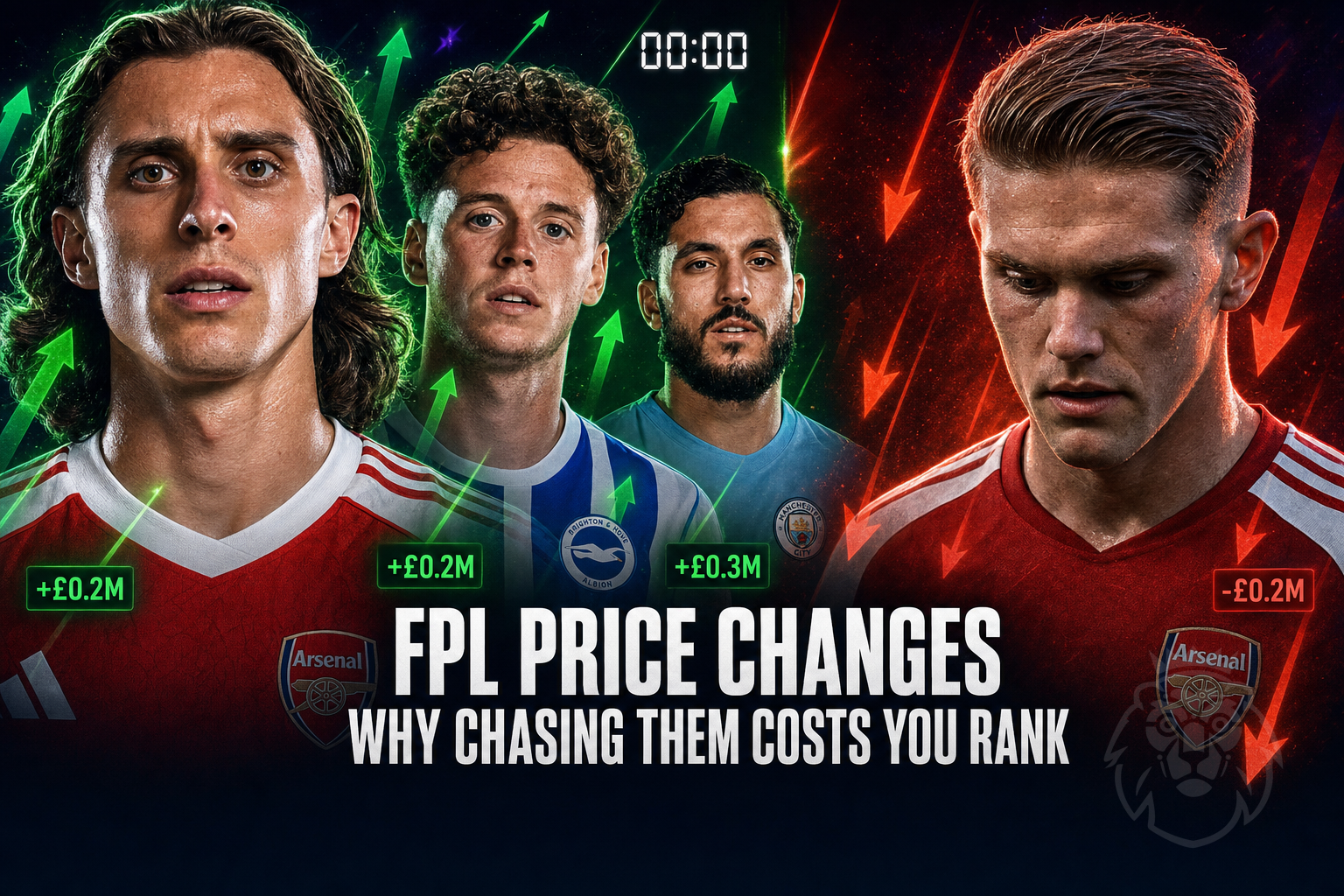
It's 11pm on a Tuesday during an international break. There's no football on. You're staring at your phone because a player you half fancy is about to go up by a tenth of a million, and you've got about an hour to decide whether that matters.
It almost never does. But the pull is real, and the reason it's real is that price changes are the one part of FPL that feels urgent every single day, while nearly everything else only matters once a week. This is how the system actually works, what the international break does to it, and the handful of rules that stop you making the expensive version of that 11pm decision.
How FPL Price Changes Actually Work
Every night at 00:00 UK time, FPL runs a price update. Players who have been bought heavily enough go up £0.1m. Players sold heavily enough go down £0.1m. A player can only move once per night, and no more than £0.3m in either direction across a single gameweek.
The trigger is net transfers measured against a threshold tied to that player's ownership. The important consequence: a player owned by 2% of managers needs far fewer net transfers to move than one owned by 40%. That's why the cheap defender nobody had last week rockets up three nights running, while a heavily-owned premium can absorb a hundred thousand transfers and not budge.
New for 2026/27, FPL publishes each player's progress toward a change as a percentage, updated every 15 minutes, on the official Price Change Predictor. Anything over 100% means he's expected to cross the line at midnight. It's a guide, not a guarantee — heavy late selling can drag a player back under 100% in the final hour.
There's also a category of player who cannot move at all: recent signings have their price locked by FPL for a spell. Right now that applies to 58 players. If someone's percentage looks frozen, that's usually why.
The 50% Sell-On Fee: The Bit That Ruins the Maths
This is the single most misunderstood rule in FPL, and it's the reason chasing rises pays worse than people think.
You only keep half of any profit. For every £0.2m a player rises while you own him, you gain £0.1m in selling price. Buy someone at £5.0m, watch him climb to £5.4m, and you can sell him for £5.2m — not £5.4m. If he rises just £0.1m, to £5.1m, your selling price doesn't move at all.
So when you're sat there at 11pm trying to beat a rise, be honest about the prize. Catching that £0.1m rise is worth £0.05m of eventual spending power. Not £0.1m. Five hundredths of a million.
And here's the reality check on scale: the biggest riser in the entire game so far this season is Cherki, up £0.3m. That's the best anyone has done in three gameweeks. Net of the sell-on fee, holding him from day one has earned you £0.15m — That's also why leaving money in the bank costs you more than a missed price rise ever will.
What the International Break Does to Prices
This is where managers do the most damage to their seasons, because the international break is the longest stretch of the year with nothing to do but tinker.
The football stops. The price changes don't. Transfers keep flowing every day, the threshold keeps getting crossed every night, and you get roughly twelve consecutive midnight updates with no matches in between to change anyone's mind. It's the most concentrated period of price movement in the FPL calendar, and it happens when you have the least new information.
Four things reliably happen during a break:
1. The template hardens. Everyone has just watched the same three gameweeks and reached the same conclusions. Millions of managers pile into the same handful of players over the same fortnight, which is how the template forms — and why a break is the cheapest time to decide whether you want to be on it. That's why the biggest rises of the season tend to land in break weeks rather than match weeks.
2. Injury news arrives late, and after the price move. Players get hurt on international duty, and the news often breaks days after the bandwagon has already rolled. You buy on Tuesday to beat a rise, he limps off for his country on Wednesday, and now you're holding an injured player you paid a premium to reach.
3. Price locks expire mid-break. Several of those 58 locked players come unlocked during this window, and a locked player who's been quietly accumulating transfers can move almost immediately once the lock lifts.
4. The falls accelerate. A player who blanked before the break bleeds owners for twelve straight days with no chance to win anyone back.
Which leads to the part almost nobody frames correctly.
During a Break, Falls Are the Real Story — Not Rises
Look at the actual state of the game right now:
| Movement this season | Players |
|---|---|
| Risen in price | 15 |
| Fallen in price | 132 |
| No change at all | 505 |
Nearly nine times more players have fallen than risen. Yet virtually all the anxiety, and all the content, is about catching rises.
You are far more likely to be holding something that's dropping than to miss something that's climbing — and the falls hurt more, because they're usually attached to a player who isn't delivering. Missing a £0.1m rise costs you £0.05m. Holding a player through a £0.3m collapse costs you real money and the points he isn't scoring.
Our guide to the players quietly wrecking your rank is the right lens for that audit.
The Arsenal Lesson: Why Fallers Actually Fall
The faller list this season is remarkable — ten of the fourteen biggest drops are Arsenal players. Gyökeres down £0.2m on zero minutes. Martinelli down £0.2m on zero minutes. Madueke, Hincapie, Eze, Zubimendi, Merino — all sliding.
Not one of those is a story about bad football. It's a story about a squad too big for its minutes. Managers bought in on reputation, the rotation didn't break their way, and the exodus followed.
That's the pattern behind most price falls, and it's worth internalising because it tells you what to check before you buy. Falls are usually a minutes problem, not a form problem. A good player who's playing will stabilise. A good player who isn't starting will keep falling until he does. Before you buy anyone during a break, the question isn't "is he good" — it's "is he definitely starting", which is exactly what the projected minutes on his profile are there for.
The Rules That Actually Save You Points
Everything above collapses into a small number of heuristics. These are the ones worth taping to the wall.
Never take a hit to beat a price rise. Not once, not ever. A hit costs you 4 points, and the expected-value maths on taking a hit is unforgiving even when you're chasing points — let alone pennies. The rise you're chasing is worth £0.05m of spending power. Team value has never won anyone a mini-league; a string of −4s has lost plenty.
Only buy early if you were buying him anyway. This is the whole test, and it's a good one. If the player is already in your plan for this gameweek, and you're merely choosing between Tuesday and Friday, then sure — buy Tuesday and bank the tenth. If the price rise is the reason you're considering him, you're not making a transfer, you're being sold one.
Don't panic-sell a good player who's falling. You'll lose more by being out of a quality asset for two gameweeks than you'll ever save by dodging £0.2m. The exception is the minutes problem above — if he's genuinely dropped out of the side, that's a football reason to sell, and the price is incidental.
Wait for team news when the two conflict. The classic break dilemma is Tuesday's price versus Friday's press conference. Take Friday almost every time. Knowing a player is fit and starting is worth vastly more than £0.05m, and the number of managers who've bought a flagged player on Tuesday to save a tenth is enormous.
Value compounds early, and stops mattering later. Most of a season's price movement happens in the first six or seven gameweeks, while ownership is still unstable. If you're going to care about value at all, The cheap defenders in our DefCon tracker are the classic early-season risers, precisely because nobody owns them yet.
When Chasing a Price Change Is Actually Right
To be fair to the other side, there are three situations where acting on price is genuinely correct.
You're already committed and it's free. You have a free transfer, you know who you're bringing in, and there's no team news left to wait for. Do it before midnight. This is just tidiness, not chasing.
You're funding a specific upgrade. Value only matters when it converts into a player you couldn't otherwise afford. If you're £0.2m short of the premium you want for a specific run of fixtures, then £0.2m of value is worth real points — that's usually a wildcard being planned properly. That's a plan. "Building value" with no destination is not.
You need to sell before a collapse you can see coming. If a player has lost his place and is dropping fast, selling early preserves the money you'll need to replace him. Again the reason is football; the price just sets the deadline.
Notice that in all three the price change is the timing, never the reason. That's the line.
Team Value Doesn't Score Points
The final thing, and the one that takes longest to accept.
There's a certain kind of FPL manager who finishes the season delighted with a £104.5m squad and a rank of 900,000. Team value is enormously satisfying to grow, and it is almost entirely decorative. It is not a score. Nobody in your mini-league can see it. It converts into points only at the exact moment you use it to buy a better player than you could otherwise afford — and if you never reach that moment, every tenth you chased was free work.
The managers who genuinely benefit from value are the ones with a plan for it: they know the premium they're building toward and the gameweek they want him for — which is exactly the discipline top-1k managers show. Everyone else is doing a very engaging form of nothing, twelve nights in a row, during an international break.
The Oracle Takeaway
Price changes run nightly at midnight, they're driven by net transfers against an ownership-weighted threshold, and you keep half of any profit you make. That last part is why the whole game is smaller than it feels: the best riser in the league this season has earned his owners £0.15m in usable value.
During an international break the movement intensifies while the information dries up, which is the worst possible combination. So spend the break auditing what you already own rather than hunting what you don't, treat a falling price as a signal to check minutes rather than to panic, and never, under any circumstances, take a hit to save a tenth.
Run your squad through Oracle's free tools to see which of your players are actually holding their place — no account needed. That's the question a price change is really asking you.
Have you ever taken a hit just to beat a price rise — and did it ever work out? 👇