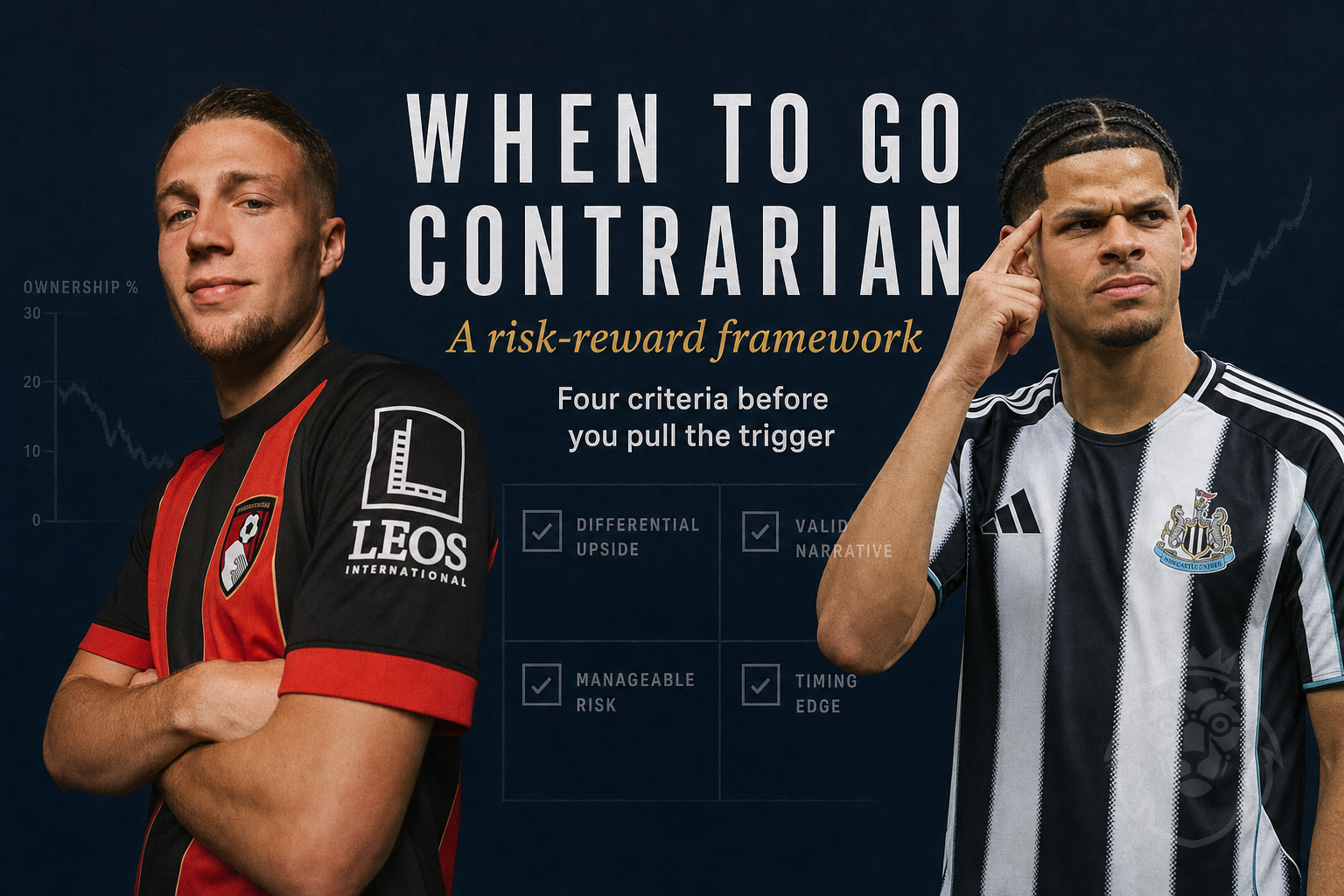
Understanding effective ownership tells you why a differential can move your rank. It does not tell you whether this week, with your specific rank gap and your specific mini-league situation, is actually the moment to take one. That gap — between understanding the mechanism and knowing when to act on it — is where most FPL strategy content stops short. This is the checklist for the moment itself: the specific criteria that separate a well-timed contrarian call from a reckless punt dressed up in the same language.
This Isn't the EO Math Again — It's the Trigger
If you need the underlying mechanics first, our effective ownership guide and our template vs differential breakdown cover why low-EO picks create asymmetric rank upside. This piece assumes you already have that foundation and answers a different, more practical question: given that a genuine differential opportunity exists, what specific conditions tell you this is actually the week to take it, rather than one to let pass?
Four criteria decide this, and none of them work in isolation. You need to check your rank gap to target, the differential's actual effective ownership, how much evidence supports the pick, and whether you're optimising for overall rank or a specific mini-league. Get one of these wrong and even a statistically sound differential can be the wrong call at the wrong time.
Criterion 1: Your Rank Gap to Target
The size of the gap between your current rank and your season target determines how much contrarian risk is actually rational to carry. A manager sitting at rank 900k with a target of top 200k needs to close roughly 700k positions — that gap cannot be closed by tracking the template, ever, regardless of how the season plays out. Contrarian calls are not optional for that manager; they are structurally necessary.
A manager sitting at rank 60k with a target of top 50k has a much smaller gap, and the correct amount of contrarian risk shrinks accordingly. This is not about contrarian calls being "wrong" at a small gap — it is about proportionality. A large gap justifies a higher frequency of differential swings because the expected value of standing still is clearly negative relative to the target. A small gap means the same swings carry disproportionate risk relative to what you actually need to gain. The full framework for translating rank situation into overall posture is covered in our rank protection vs rank climbing guide — this criterion is that framework applied specifically to the contrarian-or-not decision in front of you this week.
Criterion 2: The Differential's Actual Effective Ownership
Not every low-owned player carries the same rank upside, because raw ownership and effective ownership frequently diverge. Before treating any pick as a genuine differential, calculate its actual EO — ownership plus the additional exposure created by captain rate among owners. A player at 6% ownership with a very high captain rate among that small group might carry more EO than his headline number suggests. A player at 6% ownership who is rarely captained even by his own owners is a cleaner differential in the pure sense — his low EO is real, not just his low ownership.
This matters because the entire rank-upside case for going contrarian rests on the gap between your exposure and the field's. If the EO gap is smaller than the ownership gap suggests, the reward side of the risk-reward calculation is weaker than it looks at first glance.
Criterion 3: Sample Size — How Much Evidence Actually Supports the Pick
This is the criterion most differential content skips entirely, and it is arguably the most important. A player with two strong underlying performances in his last two matches is a much weaker evidentiary case than a player with six consecutive matches of strong xGI, even if their most recent single-match numbers look identical. Small samples are noisy. A striker who has posted 1.1 xG in his last match off a lucky run of shots is not the same case as a striker averaging 0.6 xGI per 90 across six matches with consistent underlying volume.
Before committing to a contrarian pick, ask specifically how many matches of evidence you actually have, and whether the underlying data (not just the results) has been consistent across that sample. A single standout performance is a coin flip dressed as a trend. A run of five or six matches with consistent underlying quality is a genuine signal. The screening process for distinguishing the two is covered in full in our guide to finding real FPL differentials — this criterion is the final gate before pulling the trigger on a pick that has already passed that screening.
Criterion 4: Overall Rank vs a Specific Mini-League
The correct answer to "should I go contrarian this week" can be different depending on which competition you are actually trying to win. If your primary objective is overall rank, the relevant EO is the gamewide figure, and your contrarian calibration should follow the rank-gap logic in Criterion 1 applied to the whole game.
If your primary objective is a specific mini-league, the relevant EO is scoped to your rivals, not the wider game — a player who is a genuine differential gamewide might already be owned by half your mini-league, which erases the rank-upside case within the competition that actually matters to you. Check your rivals' squads specifically before assuming a gamewide differential is also a mini-league differential; the two are not automatically the same thing, and conflating them is a common and costly mistake.
The Season Calendar Changes Your License to Be Wrong
All four criteria above should also be weighted against where you are in the season, because the cost of a contrarian call going wrong is not fixed — it depends entirely on how many gameweeks remain to recover from it. Early in the season, roughly gameweeks 1 through 15, a contrarian call that fails costs you relative ground, but there is a long runway of matches remaining to rebuild. The downside is real but recoverable, which means the bar for taking the swing can reasonably be lower.
In the run-in, roughly the final six to eight gameweeks, the same failed call is far more expensive, because there are fewer opportunities left to make up the ground it costs you. This is why the rank-mode framework consistently recommends tightening toward the template as the season closes for managers protecting a position — not because contrarian thinking stops working, but because the remaining runway to recover from a wrong call shrinks to the point where the expected value calculation genuinely shifts.
Two Real Differentials, Two Different Positions
The pattern holds across positions, not just in midfield, where most differential discussion tends to concentrate. Truffert, a Bournemouth defender priced at £4.8m and owned by just 5.3% of the game, illustrates a genuine defensive differential — a budget price point with meaningfully low EO and a current form rating of 6.5 built from 165 points, the kind of underlying consistency that separates a real case from a punt. Osula, a Newcastle forward at £5.5m owned by 2.1%, shows the same pattern at an even lower ownership level — a genuine forward differential rather than the more commonly discussed midfield case, with a form rating of 5.6 across 76 points.
Neither of these is presented here as a standing recommendation — prices, form, and ownership shift constantly, and by the time you are reading this the specific numbers may look different. What they illustrate is the pattern: genuine differentials exist across every position, not just among attacking midfielders, and the same four-criterion checklist applies regardless of where on the pitch the player sits.
Knowing that a differential exists and knowing that this is the week to take it are two different questions. The first is about the player. The second is about your rank gap, the season calendar, and which competition you're actually trying to win — and skipping straight from the first question to the trigger is how a sound strategy turns into an expensive habit.
The Oracle Takeaway
Going contrarian is not a single decision rule — it is the output of four criteria evaluated together: your rank gap to target, the pick's actual effective ownership rather than just its headline ownership, how much genuine evidence supports it, and whether overall rank or a specific mini-league is your real objective. All four should be weighted against where you are in the season, since the cost of being wrong shrinks the available recovery time as the run-in approaches.
Three actions to take this week: before your next captaincy or transfer decision, write down your actual rank gap to your season target and let that set your baseline risk tolerance. Check any differential candidate's evidence base — how many matches, how consistent the underlying data — before treating a hot streak as a trend. And if your primary stakes are a mini-league rather than overall rank, check your rivals' ownership of the pick specifically before assuming it is a differential where it counts.
FPL Oracle's recommendations already weight your specific rank ambition into every answer. Ask it directly — "should I go contrarian this week?" — and it factors your actual rank gap, not a generic answer that would apply to any manager regardless of position. Ask FPL Oracle whether this week is the week, or browse the full player pool by position on the Player Hub to source your own candidates against the criteria above.
What's the biggest factor that's stopped you pulling the trigger on a differential you were genuinely convinced by? 👇